
Δημιουργείται λογαριασμός με αυτό το email — η αγορά μπαίνει κατευθείαν σε αυτόν και τον κωδικό τον ορίζεις μετά.
Τιμή
Έκπτωση
Ποσό πληρωμής
Πώς προκύπτει το ποσό
Τιμή του νέου πλάνου
Αφαιρέθηκε (αχρησιμοποίητο από το τρέχον)
Πληρώνεις τώρα
‹ Επίλεξε τρόπο πληρωμής
Νέος τρόπος πληρωμής
—
Ποσό πληρωμής—
Την ημερομηνία—
ή πλήρωσε με κάρτα
Η παραγγελία δημιουργήθηκεΜένει να ολοκληρώσεις τον λογαριασμό σου.
Στείλαμε κωδικό στο—
——
Προς πληρωμή—
Τα στοιχεία πληρωμής θα σταλούν στο—
Προς πληρωμή
ή πλήρωσε με κάρτα
ⓘΤο όνομα γράφεται με δύο λέξεις, όπως είναι τυπωμένο στην κάρτα — για παράδειγμα Ivan Petrov
✓
Έτοιμο
How it works
How it's made
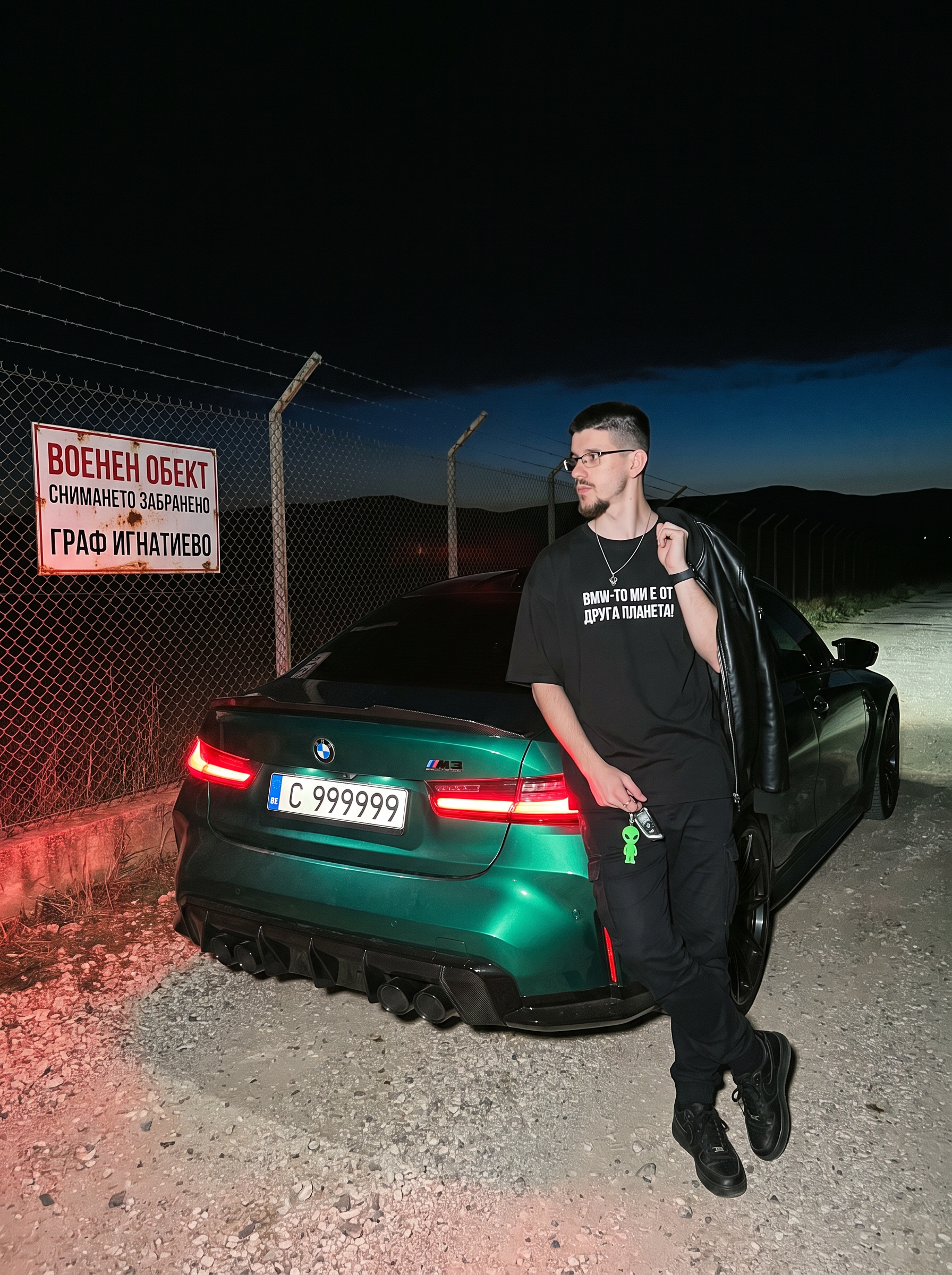
Shot 1 — Graf Ignatievo, from behind
Reference images you need
3 images:
1. The car — shot from behind or at a three-quarter rear angle, for the colour, the wheels and the body kit.
2. The person's face — a frontal portrait in clean light.
3. The person's face — profile or three-quarter profile.
The plate isn't needed as a reference — it's described in the text.
Prompt:
Use the attached references — each one has an exact role:
PHOTO 1 — THE CAR. This is the specific car that has to appear in the shot. Not a similar model — exactly this one.
PHOTO 2 — THE MAN'S FACE, reference #1. From here you take the shape of the face, the eyes, the eyebrows, the glasses and the haircut.
PHOTO 3 — THE MAN'S FACE, reference #2. From here you take the profile, the jawline, the nose, the beard and the fade on the sides.
PHOTO 2 and PHOTO 3 are the same person, shot from different angles. Combine the two to recreate his face exactly.
Create one realistic night photograph — an analogue flash frame taken on a compact film camera, vertical 4:5 format.
SCENE:
A deserted dirt road at night, gravel and dust under the wheels. A dense black sky, only a thin dark-blue strip of sunset above low mountain silhouettes in the distance. A tall chain-link fence topped with barbed wire runs behind. On the left of the frame, hooked onto the fence, a white metal sign with a red border and Cyrillic lettering on three lines:
"ВОЕНЕН ОБЕКТ" (red capital letters at the top),
"СНИМАНЕТО ЗАБРАНЕНО" (small, fine black text below it),
"ГРАФ ИГНАТИЕВО" (large black type at the very bottom).
The sign is slightly sun-faded, with rusty spots along the edges.
THE CAR — IT MUST BE EXACTLY THE ONE FROM PHOTO 1:
Carry the car from PHOTO 1 over into the new scene as one and the same physical car, not as a reconstruction from a description. Keep it unchanged:
— the exact shade of the paint: deep dark green metallic with a rich, almost emerald shine, and the way the light breaks over the curves;
— the exact shape of the body and of the rear end — the same generation, the same proportions, the same line of the boot lid and the fenders;
— the exact wheel design: the same number and shape of spokes, the same black finish, the same size;
— every factory and aftermarket detail exactly as on PHOTO 1: the boot spoiler, the rear diffuser, the position and shape of the exhaust tips, the black trim on the body, the dark window tint, the badges and lettering on the boot lid, the ride height and the wheel track.
Don't change the model, don't change the generation, don't change the colour, don't add or remove aerodynamic parts, don't make it stock or "cleaner". The only difference from PHOTO 1 is the angle, the surroundings and the lighting.
WHERE THE CAR SITS IN THE FRAME:
In the left half of the frame, shot from behind at a slight three-quarter angle, turned a little away from the camera, the rear end dominating the foreground. The LED tail lights burn deep red and cast a red glow over the gravel and over the fence behind them. The camera flash hits the paint head-on and throws a bright highlight across the boot lid and the bumper.
THE LICENSE PLATE:
Remove the original plate from PHOTO 1 and put a Bulgarian license plate in its place. European rectangular format — a white background with a thin black border, on the left a vertical blue band with a circle of twelve yellow stars and the white letters "BG" beneath them. On the white field, in solid black characters: the letter "C", a space, and after it six nines — "C 999999". The number must be clearly legible and correctly written, with no missing or added digits. The plate reflects the flash and glows bright white against the dark green paint.
THE MAN (PHOTO 2 + PHOTO 3):
Exactly the same man as in the two references — keep his face 1:1. Slim, with pronounced cheekbones and a narrow jaw, very short dark hair with a fade on the sides, a dark goatee with a moustache, rectangular glasses with a thin black metal rim on top and a rimless lower half. Keep his features, proportions, skin tone and facial structure exactly — no beautifying, no changing the nose, the jaw, the eyes or the width of the face, don't make him more muscular or younger.
POSE:
He stands on the right of the frame, leaning casually with the small of his back against the car's rear fender, his weight on one leg, the other leg lightly crossed in front. Shoulders relaxed, stance calm and confident. Body turned slightly towards the camera, head turned three-quarters away from the lens — he looks off into the darkness, not at the camera. The expression is neutral and reserved, no smile.
OUTFIT — a modern, clean street/car-culture aesthetic, an entirely masculine silhouette:
— A black short-sleeved T-shirt, oversized/boxy cut, slightly dropped shoulder, heavy cotton with a matte texture, the sleeves falling to mid-bicep. White printed Cyrillic text, capital letters, centred on three lines across the chest, legible and correctly spelled:
"BMW-ТО МИ
Е ОТ ДРУГА
ПЛАНЕТА!"
— The T-shirt is tucked in a little at the front (french tuck), the rest left loose.
— Wide, straight cargo trousers in deep graphite black, stacking slightly over the shoes, clearly defined side pockets, matte technical fabric.
— A black leather belt with a discreet matte silver buckle.
— Black high-top sneakers with a thick sole, lightly dusted from the gravel.
— A thin silver chain around his neck, resting on the neckline of the T-shirt.
— A black watch on a metal bracelet on his left wrist, one plain silver ring.
— Over his right shoulder, slung carelessly and held with two fingers — a black leather jacket (bomber/moto style), hanging down behind his back.
— In his other hand, dropped down by his thigh, he holds a BMW key with a keyring dangling from it: a light green alien with a big head and black eyes, catching the flash and glowing brightly against the dark clothes.
LIGHT AND LOOK:
Direct, hard flash from the front — sharp, contrasty, with dense black shadows right behind the subjects. A red glow from the tail lights as a second light source. Everything beyond the reach of the flash sinks into solid darkness. Natural film grain, light grain, authentic 35mm film colours, slight chromatic aberration at the edges, realistic depth of field — the car and the man in focus, the fence slightly softened.
IMPORTANT — in order of priority:
1. The car is exactly the one from PHOTO 1 — the same car, the same colour, the same wheels, the same body kit. Not a similar model, not the stock version, not a different shade of green.
2. The man's face is identical to the one in PHOTO 2 and PHOTO 3.
3. The license plate reads exactly "C 999999" with the blue EU band and "BG" — no invented digits or letters.
4. All the text is in Cyrillic and free of spelling mistakes: on the T-shirt "BMW-ТО МИ Е ОТ ДРУГА ПЛАНЕТА!", on the sign "ВОЕНЕН ОБЕКТ / СНИМАНЕТО ЗАБРАНЕНО / ГРАФ ИГНАТИЕВО".
5. Composition, framing, angle and lighting 1:1 like the original reference frame.
6. Entirely masculine clothing and a masculine silhouette, no women's accessories and no bag.
7. No distorted fingers, no deformed glasses, no extra people in the frame, no text artefacts other than the lettering specified.
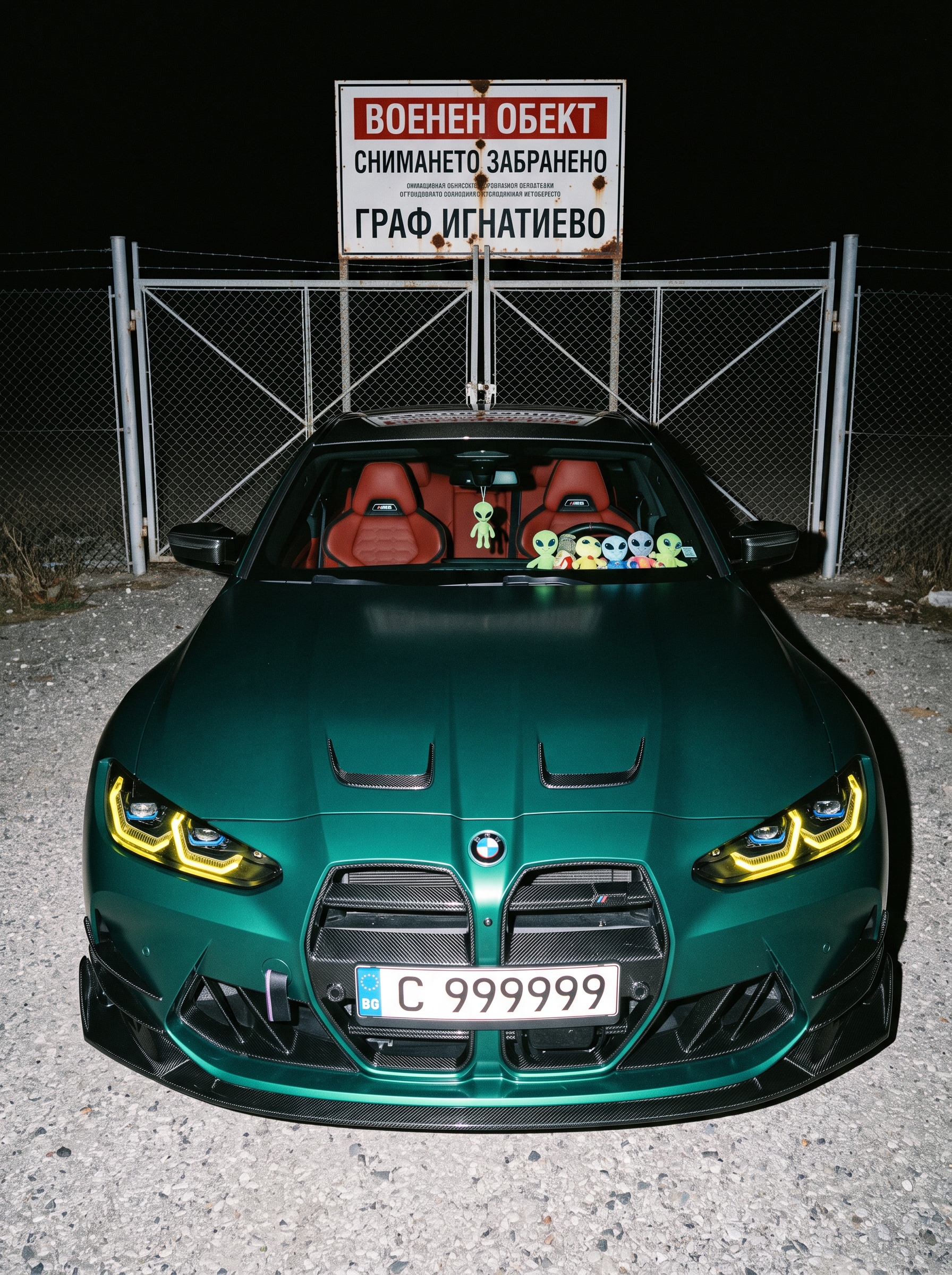
Shot 2 — the front end at the gate
Reference images you need
2 images:
1. The car — shot from the front, for the grille, the headlights and the carbon parts.
2. The license plate — a photo of the plate itself.
Prompt:
Use the attached references — each one has an exact role:
PHOTO 1 — THE CAR. This is the specific car that has to appear in the shot. Not a similar model — exactly this one.
PHOTO 2 — THE LICENSE PLATE. This is the exact plate that has to sit on the front bumper.
Create one realistic night photograph — an analogue flash frame taken on a compact film camera, vertical 4:5 format.
FRAME AND COMPOSITION:
A strictly frontal shot, the camera low, at bonnet level, exactly on the car's centre line — perfect symmetry. The car fills the lower two thirds of the frame, the front end comes at the viewer aggressively, a wide-angle perspective that stretches the bonnet. Down in the foreground — grey gravel and dust.
SCENE:
Night, a deserted dirt road. A dense black sky with no stars. Behind the car runs a tall chain-link fence with vertical steel posts and a two-wing gate exactly in the centre of the frame, behind the car's roof. On the gate, hung a little above the roofline and centred in the frame, there is a white metal sign with a black border and Cyrillic lettering on three lines:
"ВОЕНЕН ОБЕКТ" (red capital letters on a dark red band at the top),
"СНИМАНЕТО ЗАБРАНЕНО" (black text, and below it two more lines of very small, fine, illegible official text),
"ГРАФ ИГНАТИЕВО" (large black type at the very bottom).
The sign is slightly sun-faded, with small rusty spots along the edges.
THE CAR — IT MUST BE EXACTLY THE ONE FROM PHOTO 1:
Carry the car from PHOTO 1 over into the new scene as one and the same physical car, not as a reconstruction from a description. Keep it unchanged:
— the exact shade of the paint: deep dark green with a satin, slightly matte metallic finish that goes from a lighter emerald where the light hits it to almost black-green in the shadows on the fenders;
— the exact shape of the front end: the same big vertical grille with carbon inserts and black slats, the same headlights with the shape and layout of the light elements as on PHOTO 1, the same bonnet vents, the same wide fenders;
— every carbon part exactly as on PHOTO 1: the front splitter/lip in bare carbon with a visible weave, the carbon inserts in the grille and in the side vents, the black canards;
— the black roof and the dark window tint;
— the colour of the lit headlights exactly as on PHOTO 1 — yellow light strips along the contour with deep blue accents further in.
Don't change the model, don't change the generation, don't shift the colour towards a lighter or glossier green, don't remove or add aerodynamic parts, don't make it stock. The only difference from PHOTO 1 is the angle, the surroundings and the lighting.
THE LICENSE PLATE (PHOTO 2):
On the front bumper, centred horizontally under the grille and above the carbon splitter, mounted flat on the bumper, sits a Bulgarian license plate. The elongated European rectangular format — a white background with a thin black border, on the left a vertical blue band with a circle of twelve yellow stars and the white letters "BG" beneath them. On the white field, in solid black characters: the letter "C", a space, and after it six nines — "C 999999". The number must be clearly legible and correctly written, with no missing, added or shuffled digits. The plate reflects the flash and glows bright white against the dark green paint.
THE INTERIOR THROUGH THE WINDSCREEN:
Through the windscreen you can see two sports seats with high backrests and cut-outs for the harnesses, upholstered in deep red leather with black inserts. On the dashboard, lined up in a row at the base of the windscreen on the passenger side, sit four or five small plush alien toys: two light green ones with big black almond eyes, one grey-white one, one red one with tentacles and another green one further in. From the rear-view mirror hangs a small green alien figure on a string, tilted slightly to one side. All of it is lit by the flash and reads clearly.
LIGHT AND LOOK:
Direct, hard flash from the front — sharp and contrasty. A bright highlight on the bonnet and on the carbon weave, dense black shadows right behind the car, the gravel in the foreground blown out by the flash and darkening fast further into the frame. The fence behind the car is barely lit and disappears into the darkness at the edges of the frame. Natural film grain, light grain, authentic 35mm film colours, slight chromatic aberration at the edges, realistic depth of field — the car and the plate in focus, the fence slightly softened. No other light sources.
IMPORTANT — in order of priority:
1. The car is exactly the one from PHOTO 1 — the same car, the same satin green shade, the same headlights, the same carbon parts, the same grille. Not a similar model, not the stock version, not a lighter or glossier green.
2. The license plate reads exactly "C 999999" with the blue EU band and "BG", as on PHOTO 2 — no invented digits or letters.
3. The text on the sign is in Cyrillic and free of spelling mistakes: "ВОЕНЕН ОБЕКТ / СНИМАНЕТО ЗАБРАНЕНО / ГРАФ ИГНАТИЕВО".
4. Strict frontal symmetry — the car looks straight into the lens, the gate and the sign centred behind it.
5. No people in the frame, no other cars, no text artefacts other than the lettering specified.
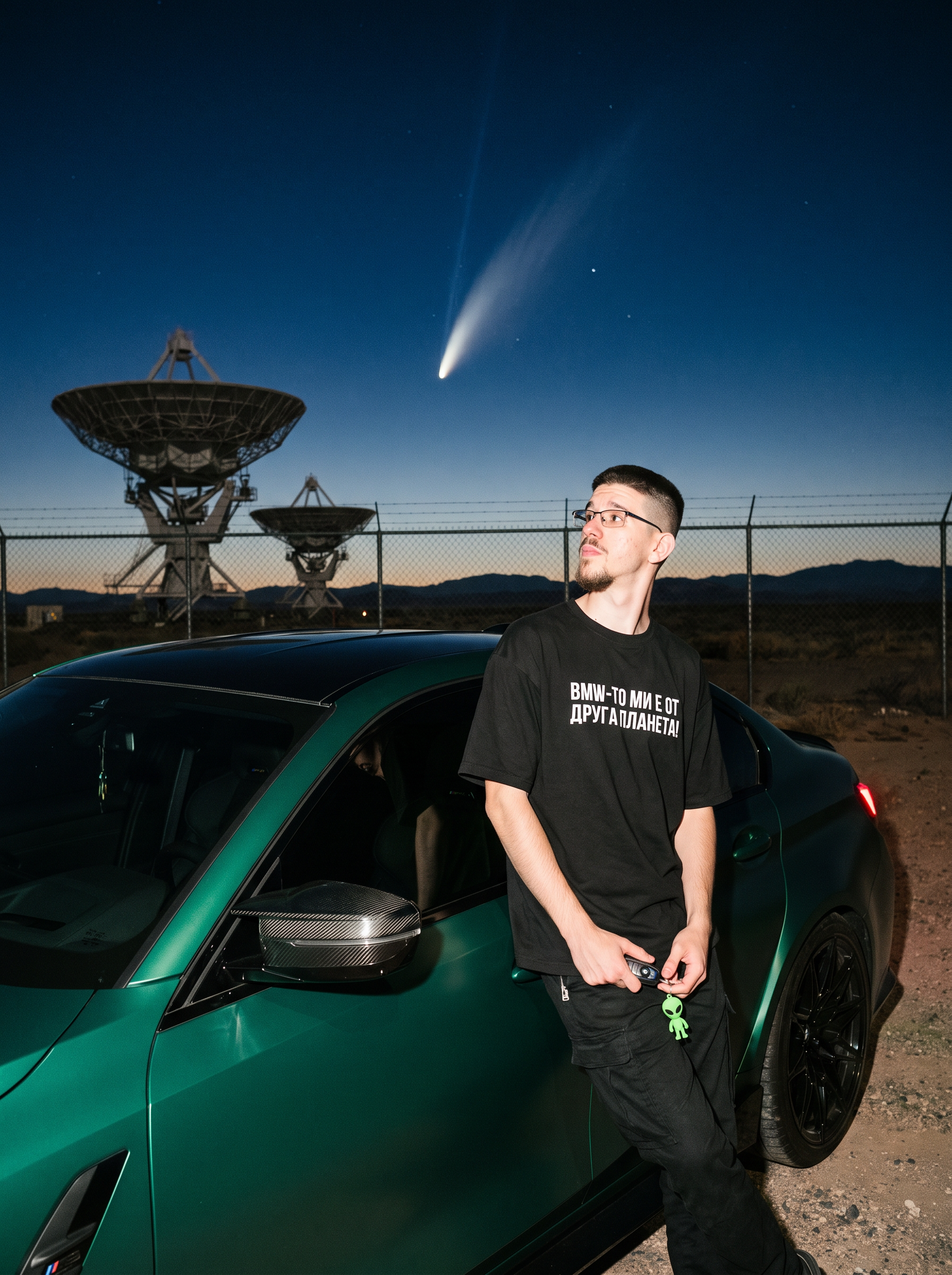
Shot 3 — the comet
Reference images you need
3 images:
1. The car — a side or three-quarter view, for the colour, the doors, the mirror and the wheels.
2. The person's face — a frontal portrait.
3. The person's face — profile.
No plate needed — the front bumper is out of frame.
Prompt:
Use the attached references — each one has an exact role:
PHOTO 1 — THE CAR. This is the specific car that has to appear in the shot. Not a similar model — exactly this one.
PHOTO 2 — THE MAN'S FACE, reference #1. From here you take the shape of the face, the eyes, the eyebrows, the glasses and the haircut.
PHOTO 3 — THE MAN'S FACE, reference #2. From here you take the profile, the jawline, the nose, the beard and the fade on the sides.
PHOTO 2 and PHOTO 3 are the same person, shot from different angles. Combine the two to recreate his face exactly.
Create one realistic night photograph — an analogue flash frame taken on a compact film camera, vertical 4:5 format.
FRAMING — THE MOST IMPORTANT THING IN THIS SHOT:
A very tight shot. The camera stands about a metre and a half from the car, to its left, at waist level, with a wide-angle lens. It is so close that the car does NOT fit in the frame.
— The car takes up the whole lower half of the image and is cut off by the left and the bottom edge of the frame.
— Only these are in frame: the front fender, the mirror, the front door, part of the rear door and the roof. The front bumper, the headlights and the rear end stay outside the frame. The door handle and the mirror cap are in the foreground, big and sharply detailed.
— The body of the car crosses the frame diagonally: lower on the left, rising to the right.
— The man is in the right centre, in the foreground, in a tight shot — visible from mid-thigh up and taking up almost the entire height of the upper half of the frame. His head sits roughly one third of the way down from the top.
— The horizon line runs low, right behind the car's roof.
— The top third of the frame is clear sky with the comet.
Do NOT make it a wide shot. Do NOT show the whole car. Do NOT leave empty space to the left or the right of the car. Do NOT push the man back — he is close to the lens, not a small figure in the background. The frame has to be dense and packed, with no air at the edges.
SCENE:
Dusk, just after sunset, in an empty flat landscape. The sky is a gradient: dense dark blue-black at the very top, moving into a deep blue, and at the very bottom, down to the horizon — a narrow warm orange-amber strip. A bright comet streaks diagonally across the upper part of the sky — a blinding white-blue core with a long glowing tail that breaks into several sparks and leaves a thin hazy trail.
In the background, as dark silhouettes against the sky, stand two huge parabolic radio telescopes on latticed steel structures. Below them — the jagged silhouette of a distant mountain ridge. Right behind the car runs a tall chain-link fence with barbed wire on top. Below — desert ground, gravel, low dry shrubs.
THE CAR — IT MUST BE EXACTLY THE ONE FROM PHOTO 1:
Carry the car from PHOTO 1 over into the new scene as one and the same physical car, not as a reconstruction from a description. Keep it unchanged:
— the exact shade of the paint: deep dark green with a satin, slightly matte metallic finish that lightens to emerald where the light hits it and darkens almost to black-green in the shadows;
— the glossy black roof and the dark tint on all the windows;
— the exact shape of the body and of the front end: the same big vertical grille in black, the same headlights with yellow light strips along the contour, the same bonnet vents, the same wide fenders and the side vent on the front wing;
— every carbon and black part exactly as on PHOTO 1: the front splitter, the side skirts, the mirror caps, the black door handles;
— the exact wheel design: the same black multi-spoke wheels, the same size, the same yellow brake calipers, the same ride height.
Don't change the model, don't change the generation, don't shift the colour towards a lighter or glossier green, don't remove or add aerodynamic parts, don't make it stock.
THE MAN (PHOTO 2 + PHOTO 3):
Exactly the same man as in the two references — keep his face 1:1. Slim, with pronounced cheekbones and a narrow jaw, very short dark hair with a fade on the sides, a dark goatee with a moustache, rectangular glasses with a thin black metal rim on top and a rimless lower half. Keep his features, proportions, skin tone and facial structure exactly — no beautifying, no changing the nose, the jaw, the eyes or the width of the face, don't make him more muscular or younger. The face is big enough in the frame to be clearly recognisable.
POSE:
He leans with the small of his back and his hips against the car's front right door, right behind the mirror. His back is arched slightly, shoulders rolled back, his weight on one leg, the other leg pushed a little forward. His head is tipped back and up, chin raised, face turned upwards and over his shoulder — he is looking at the comet behind and above him, not at the camera. The profile and the jawline read clearly against the dark sky. The expression is calm and thoughtful, no smile. One hand is dropped down by his thigh and holds a BMW key with a keyring dangling from it: a light green alien with a big head and black eyes. The other hand is slightly behind him, palm propped on the edge of the door.
OUTFIT — a modern, clean street/car-culture aesthetic, an entirely masculine silhouette:
— A black short-sleeved T-shirt, oversized/boxy cut, slightly dropped shoulder, heavy cotton with a matte texture. White printed Cyrillic text, capital letters, centred on three lines across the chest, legible and correctly spelled:
"BMW-ТО МИ
Е ОТ ДРУГА
ПЛАНЕТА!"
Because his body is arched back, the text is seen at a slight angle, but it stays fully legible.
— The T-shirt is tucked in a little at the front, the rest left loose.
— Wide, straight cargo trousers in deep graphite black, stacking slightly over the shoes, clearly defined side pockets, matte technical fabric.
— A black leather belt with a discreet matte silver buckle.
— Black high-top sneakers with a thick sole, lightly dusted from the gravel.
— A thin silver chain around his neck, resting on the neckline of the T-shirt.
— A black watch on a metal bracelet on his left wrist, one plain silver ring.
LIGHT AND LOOK:
Direct, hard flash from the front — sharp and contrasty. It lights the car and the man brightly, brings out the satin texture of the green and the white print on the T-shirt, and throws a dense black shadow immediately behind them. Everything beyond its reach — the fence, the telescopes, the ridge — falls into silhouette against the glowing sky. The comet is a second, cold light accent up above. Natural film grain, light grain, authentic 35mm film colours, slight chromatic aberration at the edges, realistic depth of field — the car and the man in focus, the background slightly softened.
IMPORTANT — in order of priority:
1. THE FRAMING: a tight, dense shot. The car is cut off by the left and bottom edge, the man is big in the foreground. No wide shot at all.
2. The car is exactly the one from PHOTO 1 — the same satin green shade, black roof, the same wheels and body kit.
3. The man's face is identical to the one in PHOTO 2 and PHOTO 3, seen in three-quarter profile from below.
4. The text on the T-shirt is in Cyrillic and free of spelling mistakes: "BMW-ТО МИ Е ОТ ДРУГА ПЛАНЕТА!".
5. The comet must be there — bright, with a long tail, running diagonally across the upper part of the sky.
6. Entirely masculine clothing and a masculine silhouette, no women's accessories and no bag.
7. No distorted fingers, no deformed glasses, no extra people in the frame, no text artefacts other than the lettering specified.
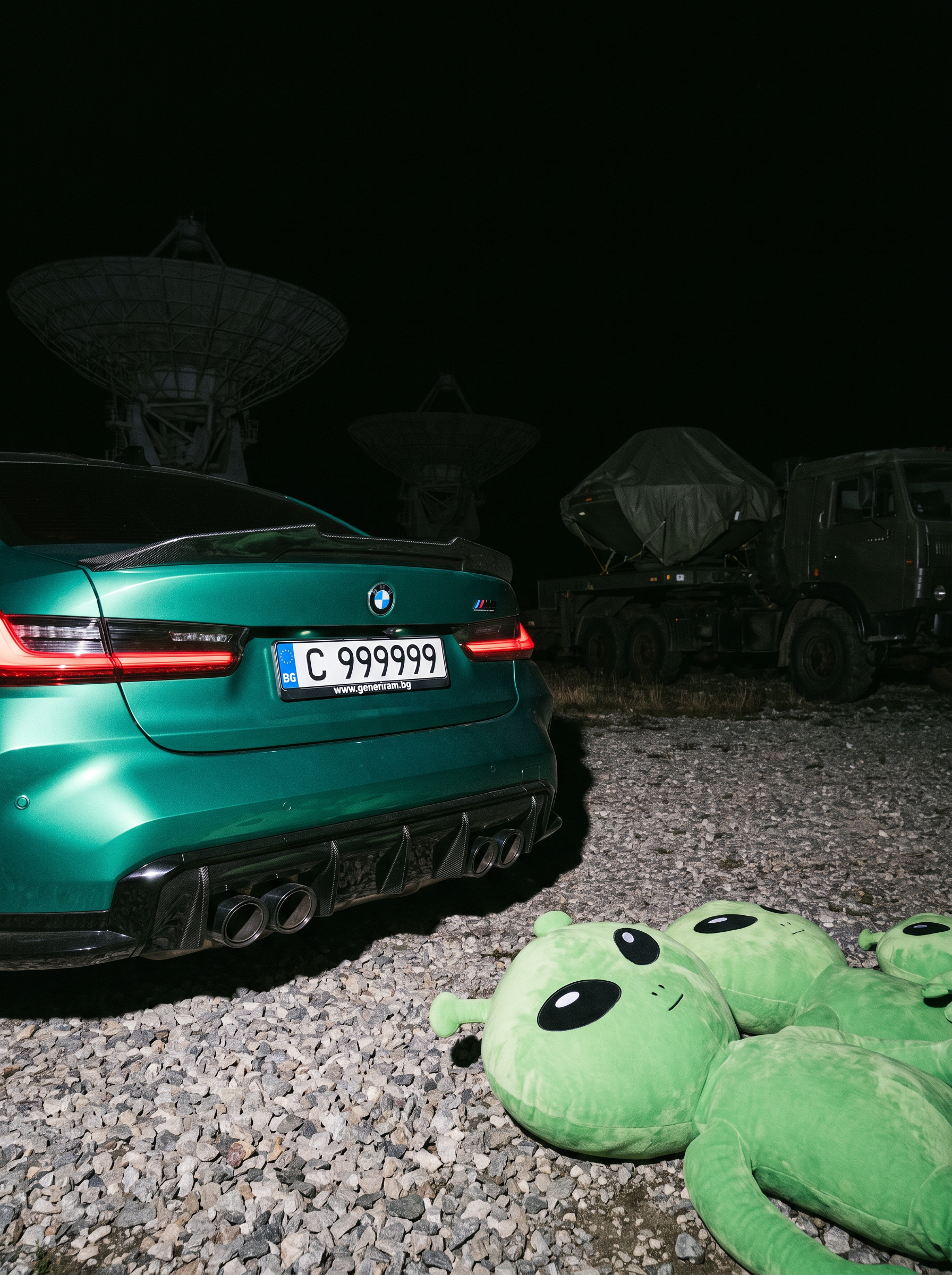
Shot 4 — the plush aliens
Reference images you need
3 images:
1. The car — shot from behind, for the tail lights, the diffuser and the exhaust tips.
2. The car — from behind at a different angle, for the shape of the rear end and the wheels.
3. The license plate — a photo of the plate itself.
Prompt:
Use the attached references — each one has an exact role:
PHOTO 1 — THE CAR, rear view. This is the specific car that has to appear in the shot. Not a similar model — exactly this one.
PHOTO 2 — THE CAR, rear view from a different angle. Use it together with PHOTO 1 for the shape of the rear end, the diffuser, the exhaust tips and the wheels.
PHOTO 3 — THE LICENSE PLATE. This is the exact plate that has to sit on the rear bumper.
Create one realistic night photograph — an analogue flash frame taken on a compact film camera, vertical 4:5 format.
FRAMING — THE MOST IMPORTANT THING IN THIS SHOT:
A very low angle, the camera almost on the ground — about thirty centimetres above the gravel, very close to the rear bumper, slightly to the left of the car's centre line, with a wide-angle lens. It is so close that the car does not fit in the frame.
— The rear end of the car takes up the whole left half and the upper left part of the image, cut off by the left and the top edge of the frame. You can see the boot lid with the spoiler, the badges, the tail lights, the bumper, the diffuser and the exhaust tips. The front of the car is outside the frame.
— From the bottom right corner and off to the right, an open flat expanse of gravel opens up, leading away towards the horizon.
— The bottom right corner of the frame is taken up by plush toys lying on the gravel, very close to the lens and big in the foreground.
— The sky takes up only a narrow strip in the upper right and is dense black.
The frame is dense and packed, with no air on the left. Do NOT make it a wide shot, do NOT show the whole car, do NOT raise the camera to eye level.
SCENE:
Deep night, an empty flat landscape, fine grey gravel and dust on the ground. The sky is dense black, with no stars and no sunset.
In the distance on the left, as dark silhouettes, stand two huge parabolic radio telescopes on latticed steel structures — one nearer and bigger in the upper left corner, the second further in and smaller. They are pointed upwards.
On the right, in the middle ground, some way from the car, an army truck with a flatbed trailer is parked. On the trailer lies a large disc-shaped object, wrapped tightly in olive green tarpaulin and strapped down — its outline vaguely suggests a flying saucer. The truck is dimly lit, half in shadow.
THE CAR — IT MUST BE EXACTLY THE ONE FROM PHOTO 1 AND PHOTO 2:
Carry the car from the references over into the new scene as one and the same physical car, not as a reconstruction from a description. Keep it unchanged:
— the exact shade of the paint: deep dark green with a satin metallic finish that lightens to emerald where the light hits it and darkens almost to black-green in the shadows;
— the glossy black roof and the dark tint on all the windows;
— the exact shape of the rear end: the same slim LED tail lights, the same line of the boot lid, the same spoiler, the same badges on the boot lid;
— the black diffuser and the exact position and shape of the exhaust tips as they are in the references;
— the black multi-spoke wheels, the same size, the same yellow brake calipers, the same ride height.
The tail lights burn deep red and cast a red glow over the gravel behind the car.
Don't change the model, don't change the generation, don't shift the colour towards a lighter or glossier green, don't remove or add parts on the body.
THE LICENSE PLATE (PHOTO 3) AND THE FRAME UNDER IT:
On the rear bumper, clearly visible and well lit by the flash, sits a Bulgarian license plate. The elongated European rectangular format — a white background with a thin black border, on the left a vertical blue band with a circle of twelve yellow stars and the white letters "BG" beneath them. On the white field, in solid black characters: the letter "C", a space, and after it six nines — "C 999999".
Immediately below the plate, along the bottom edge of its frame, runs a narrow black plastic strip — an advertising plate frame, the kind car dealers fit. On it, centred, in small white capital letters in the Latin alphabet, exactly and only this address is written:
www.genkiki.com
The text must be clearly legible, spelled out letter by letter without mistakes, with no added words and no other lettering on the frame.
THE PLUSH ALIENS:
In the bottom right corner of the frame, dropped carelessly on the gravel and very close to the lens, lie four or five big plush alien toys: two light green ones with huge black almond eyes, one grey-white one with a bigger head, one smaller green one in a dark waistcoat. The plush is clearly textured, brightly lit by the flash, with soft shadows between their bodies.
LIGHT AND LOOK:
Direct, hard flash from the camera — sharp and contrasty. It lights the rear of the car, the plate, the gravel and the plush toys in the foreground brightly, and brings out the satin texture of the green and the metallic shine on the exhaust tips. Dense black shadows right behind the subjects. The red glow from the tail lights is a second light source. The radio telescopes and the truck stay dark silhouettes, barely touched by the light. Everything beyond the reach of the flash sinks into solid darkness. Natural film grain, pronounced grain, authentic 35mm film colours, a slight cold greenish cast in the shadows, realistic depth of field — the car and the toys in focus, the background slightly softened.
IMPORTANT — in order of priority:
1. THE FRAMING: an extremely low angle, the camera almost on the ground, very close to the rear bumper. The car is cut off on the left and at the top. No wide shot at all.
2. The car is exactly the one from PHOTO 1 and PHOTO 2 — the same satin green shade, black roof, the same tail lights, diffuser, exhaust tips and wheels.
3. The license plate reads exactly "C 999999" with the blue EU band and "BG", as on PHOTO 3.
4. Under the plate there must be a black advertising frame with white text reading exactly "www.genkiki.com" — legible, with no spelling mistakes and no other lettering.
5. The plush aliens are big in the bottom right corner, clearly lit by the flash.
6. The army truck with the tarpaulin-covered disc-shaped object is there in the middle ground on the right.
7. No people in the frame, no other cars, no text artefacts other than the plate and the address.
Shot 5 — the interior with the alien
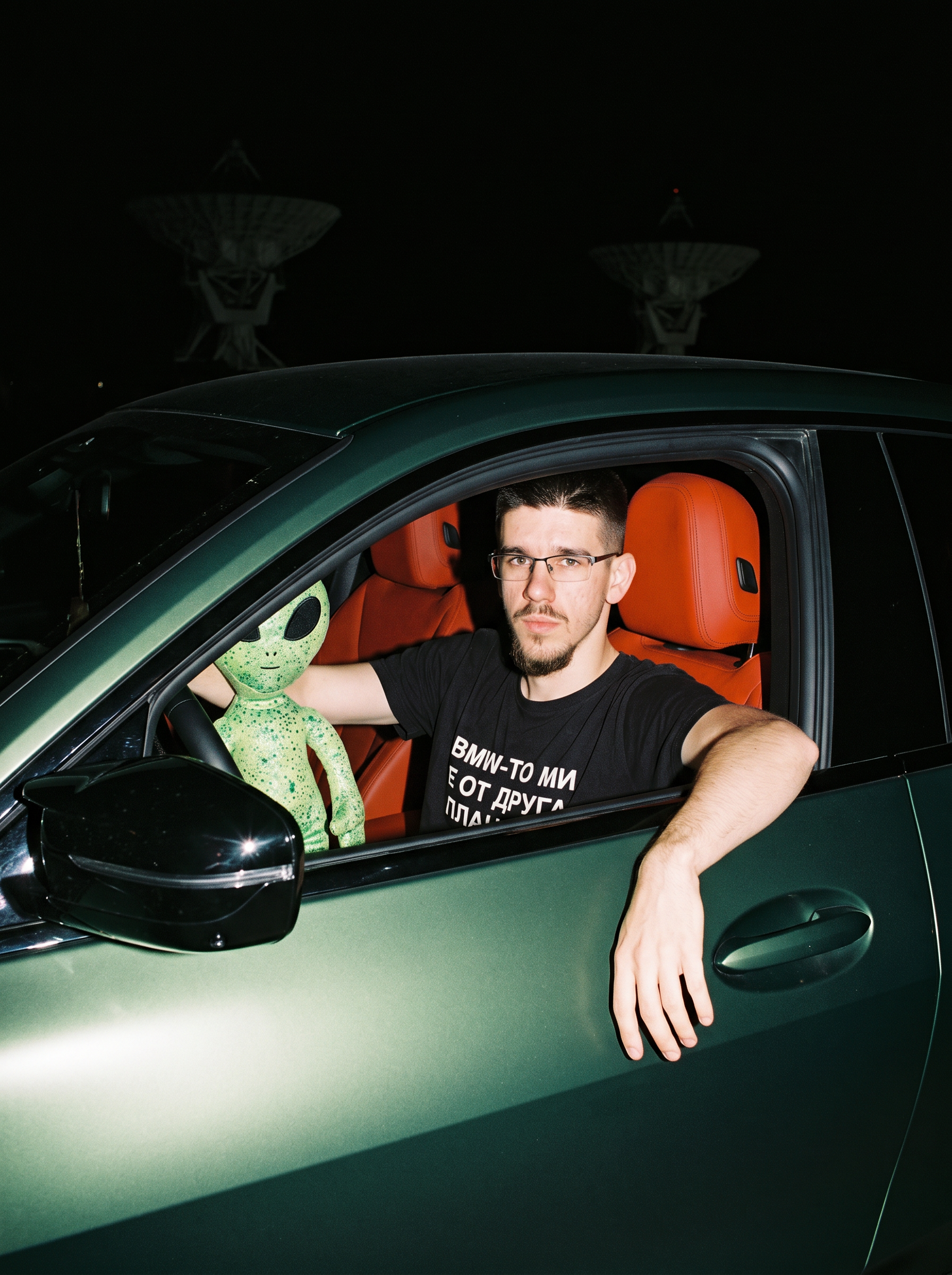
Reference images you need
2 images:
1. The person's face — a frontal portrait in clean light.
2. The person's face — profile or three-quarter profile.
No car needed — only the door shows and it is described in the text.
Prompt:
Use the attached references — each one has an exact role:
PHOTO 1 — THE MAN'S FACE, reference #1. From here you take the shape of the face, the eyes, the eyebrows, the glasses and the haircut.
PHOTO 2 — THE MAN'S FACE, reference #2. From here you take the profile, the jawline, the nose, the beard and the fade on the sides.
PHOTO 1 and PHOTO 2 are the same person, shot from different angles. Combine the two to recreate his face exactly. That is the top priority of this shot.
Create one realistic night photograph — an analogue flash frame taken on a compact film camera, vertical 4:5 format.
FRAMING:
The camera stands outside next to the car, at window-frame level, very close — about a metre away. It shoots inwards through the fully lowered window of the front left door.
— The lower third of the frame is taken up by the outside of the car door, big and close to the lens, cut off by the bottom and the left edge.
— The window frame runs as a dark arc across the upper third of the frame, framing the opening.
— The window opening is a "frame within the frame" and through it you see the lit interior.
— The man is sitting in the driver's seat, in the right half of the opening, his body leaning slightly towards the window, his shoulders cut off by the right edge of the frame.
— The plush toy takes up the left centre of the opening, big, almost as tall as his torso.
— Above the roof, in the top part of the frame — solid darkness.
The frame is dense and close. Do NOT make it a wide shot, do NOT show the whole car, do NOT pull the camera back.
THE CAR FROM OUTSIDE:
Only the front left door and the window frame are visible. The paint is a deep dark green with a satin, slightly matte metallic finish — the flash falls across the door at an angle and leaves a bright white highlight along its edge, the rest sinking into deep black-green. The window frame and the mirror base are glossy black. The window is all the way down.
THE INTERIOR:
Sports seats with high backrests, upholstered in deep red-orange leather with pronounced side bolsters and cut-outs for the harnesses in the backrest. Black carbon inserts on the backs of the seats. A black dashboard, a black door handle, a black steering wheel with red and blue M stitching. The centre console is black with climate buttons on the left of the frame and a short gear lever. The contrast between the red-orange leather and the black surfaces is strong and reads clearly under the flash.
THE MAN (PHOTO 1 + PHOTO 2):
Exactly the same man as in the two references — keep his face 1:1. Slim, with pronounced cheekbones and a narrow jaw, very short dark hair with a fade on the sides, a dark goatee with a moustache, rectangular glasses with a thin black metal rim on top and a rimless lower half. Keep his features, proportions, skin tone and facial structure exactly — no beautifying, no changing the nose, the jaw, the eyes or the width of the face, don't make him more muscular or younger. The face is big in the frame and fully recognisable.
POSE — relaxed, self-assured, with a touch of humour:
He sits loosely in the driver's seat, his back against the backrest, shoulders open. His left arm is slung out through the frame of the lowered window, the elbow propped on the edge of the door, the wrist hanging freely down — the classic pose of a man who has pulled over at a lay-by.
His right arm is stretched out to the side and holds the big plush toy upright next to him, gripping it casually by the back of the neck with one hand, the way you hold a mate by the neck — the toy is sitting on the passenger seat, leaning slightly towards him, but he is NOT hugging it, NOT pressing it to his chest and NOT holding it with both hands.
His head is turned straight at the camera, chin slightly raised. The expression is completely deadpan, serious, no smile — as if nothing unusual is going on. It is exactly this contrast between the stone face and the alien beside him that makes the shot funny.
THE PLUSH TOY:
A big plush alien, as tall as his torso, light green with a mottled darker green tone on the skin, a huge elongated head, big black almond eyes with a white highlight, thin arms. It sits upright in the passenger seat, facing the camera, its head tilted slightly to one side. Brightly lit by the flash, the green glowing hard against the red-orange leather.
THE CLOTHES:
A black short-sleeved T-shirt, heavy matte cotton, a slightly loose cut. White printed Cyrillic text, capital letters, on three lines across the chest:
"BMW-ТО МИ
Е ОТ ДРУГА
ПЛАНЕТА!"
Because his body is cut off by the right edge of the frame, the beginning of the lines is fully visible while the end runs partly out of frame. The visible part of the text must be correctly spelled, with no wrong letters. A thin silver chain around his neck, a black watch on his left wrist.
BACKGROUND:
Through the rear window and above the roof — solid night. Very faintly, barely made out in the darkness, the silhouettes of two huge parabolic radio telescopes are outlined. No other light sources.
LIGHT AND LOOK:
Direct flash from the camera — sharp and close. It burns the edge of the door and the window frame white, lights the face, the toy and the red-orange leather brightly, and leaves a deep shadow further into the cabin. Highlights on the lenses of the glasses and on the toy's black eyes. Everything outside the cabin sinks into solid black. Pronounced film grain, authentic 35mm film colours, slight chromatic aberration at the edges, a slight cold cast in the shadows.
IMPORTANT — in order of priority:
1. The man's face is identical to the one in PHOTO 1 and PHOTO 2, looking straight at the camera.
2. THE FRAMING: a tight shot through the lowered window, the door cut off at the bottom left, the window as a frame within the frame.
3. The pose is masculine and relaxed — elbow out through the window, the toy held casually by the back of the neck with one hand, sitting next to him. No hug, no pressing it close, no both hands around it.
4. The expression is deadpan and serious, no smile.
5. The interior is in deep red-orange leather, the body outside is satin dark green.
6. The text on the T-shirt is in Cyrillic, the visible part free of spelling mistakes.
7. No distorted fingers, no deformed glasses, no extra people in the frame.
Shot 6 — the trailer with the saucer
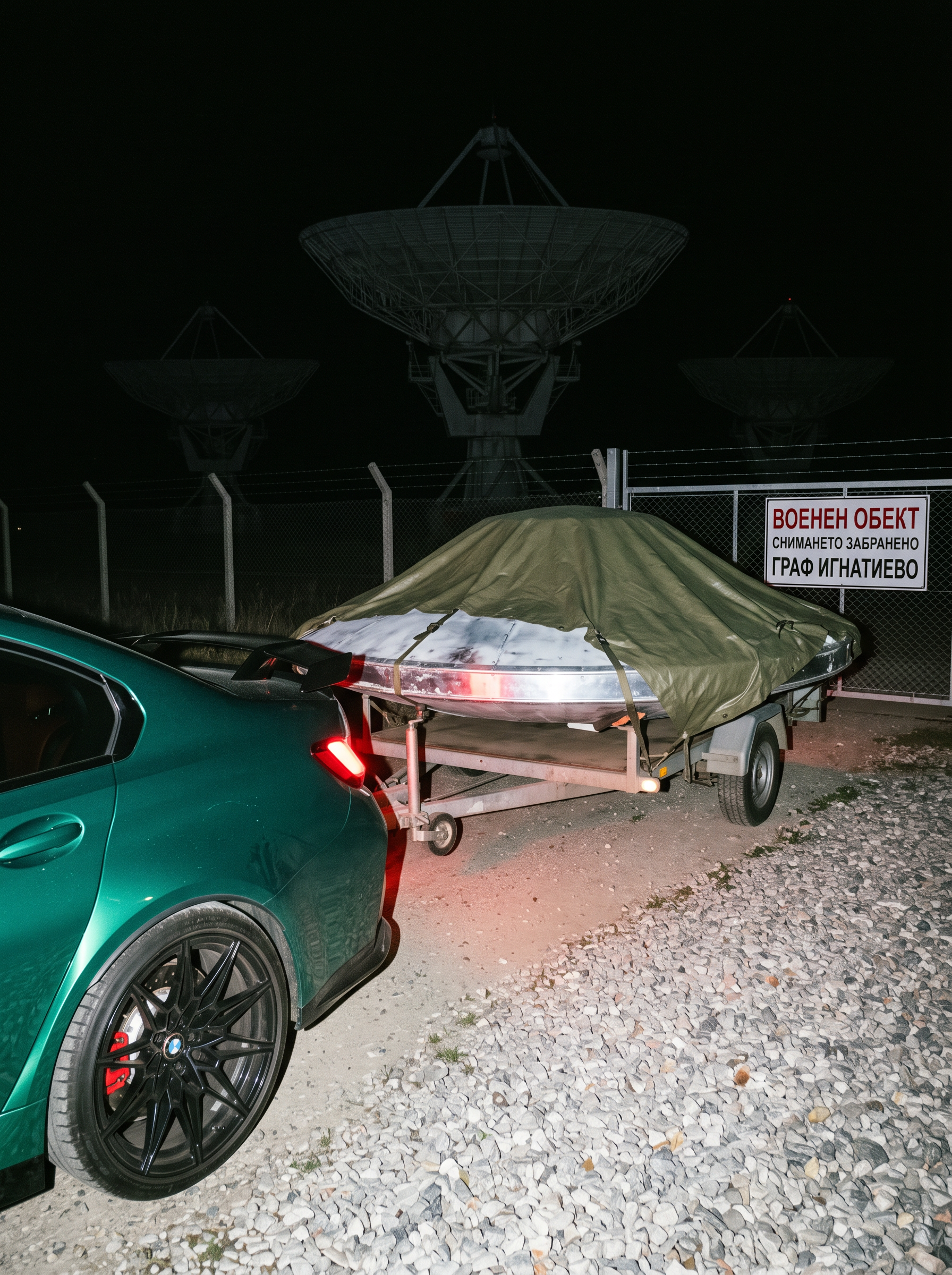
Reference images you need
1 image:
1. The car — a side or three-quarter view, for the colour, the wheels and the brake calipers.
No plate needed — the rear plate is turned away from the camera.
Prompt:
Use the attached reference:
PHOTO 1 — THE CAR. This is the specific car that has to appear in the shot. Not a similar model — exactly this one.
Create one realistic night photograph — an analogue flash frame taken on a compact film camera, vertical 4:5 format.
FRAMING:
The camera stands on the ground behind and to the left of the car, at waist level, with a slightly wide-angle lens. The frame looks at an angle past the rear of the car towards the trailer behind it.
— The bottom left corner is taken up by the rear of the car — you can see the boot lid with the spoiler, the tail light, the rear wing and the rear wheel. The car is cut off by the left and the bottom edge of the frame and takes up roughly the lower left quarter of the image. Its front end is outside the frame.
— From the rear of the car a tow bar runs backwards, leading the eye to the trailer.
— The trailer with its covered load is in the centre of the frame, turned at a slight angle, and takes up the middle third of the image in height.
— The upper half of the frame is night sky with the silhouettes of the radio telescopes.
— The bottom right corner and the whole foreground on the right are grey gravel, brightly lit by the flash.
SCENE:
Deep night, an empty flat landscape, fine grey gravel and dust. The sky is dense black, with no stars.
In the background, as dark silhouettes against the sky, stand three parabolic radio telescopes on latticed steel structures — one big and dominant in the upper centre, tilted upwards, and two smaller and further away to the left and right of it.
Right behind the trailer runs a low chain-link fence with steel posts. On the right of the fence, at the height of the load, hangs a white metal sign with a black border and Cyrillic lettering on three lines:
"ВОЕНЕН ОБЕКТ" (red capital letters on a dark red band at the top),
"СНИМАНЕТО ЗАБРАНЕНО" (smaller black text below it),
"ГРАФ ИГНАТИЕВО" (large black type at the very bottom).
The sign is slightly sun-faded, with small rusty spots along the edges, and is clearly legible under the flash.
THE CAR — IT MUST BE EXACTLY THE ONE FROM PHOTO 1:
Carry the car from PHOTO 1 over into the new scene as one and the same physical car, not as a reconstruction from a description. Keep it unchanged:
— the exact shade of the paint: deep glossy emerald green metallic with a deep wet shine that mirrors the light along the curves of the fender and darkens almost to black-green in the shadows;
— the black roof and the dark window tint;
— the exact shape of the rear end and of the rear wing, the line of the boot lid, the boot spoiler and the slim LED tail light;
— the black multi-spoke wheels with the same design and the same number of spokes, and the deep red brake calipers behind them;
— the black side skirts and the black trim on the body.
Don't change the model, don't change the generation, don't shift the colour towards a more matte, darker or bluer green, don't remove or add parts on the body.
The tail light burns deep red and casts a red glow over the gravel and over the tow bar.
THE TOW BAR:
Under the rear bumper a solid steel tow bar is fitted, running back out from under the car and reaching the trailer's coupling. The metal is matte grey, lightly dusted, and reflects the flash with a hard shine. The link between the car and the trailer is clearly visible — the car is obviously towing the load.
THE TRAILER AND THE LOAD:
A low single-axle flatbed trailer with an aluminium frame, vertical metal supports and cross braces, one wheel with a black tyre visible on the right. On it lies a large, clearly disc-shaped object — a flying saucer. It is wrapped tightly in a heavy tarpaulin in worn olive green, which falls in big folds and is tied down along the edges. From under the tarpaulin, at the front, part of the disc itself shows: a smooth grey-green metal surface with a polished aluminium rim along the edge, pitted and scratched from use. The shape under the tarpaulin unmistakably gives away a round, domed body. The trailer is turned at a slight angle to the camera, so that both its front and one of its sides are visible.
LIGHT AND LOOK:
Direct, hard flash from the camera — sharp and contrasty. It lights the rear of the car, the tow bar, the trailer, the tarpaulin and the gravel in the foreground brightly, and brings out the texture of the canvas and the wet shine of the green. Dense black shadows right behind the subjects. The radio telescopes stay dark silhouettes against the black sky, barely touched by the light. Everything beyond the reach of the flash sinks into darkness. Pronounced film grain, authentic 35mm film colours, a slight cold greenish cast in the shadows, realistic depth of field — the car, the trailer and the sign in focus, the telescopes slightly softened.
IMPORTANT — in order of priority:
1. The car is exactly the one from PHOTO 1 — the same glossy emerald green shade, the same black wheels, the same red brake calipers, the same shape of the rear end.
2. THE FRAMING: the car is only in the bottom left corner, cut off on the left and at the bottom. The trailer is in the centre. No wide shot at all, no whole car in the frame.
3. The car is physically hitched to the trailer with a tow bar — the link is clearly visible.
4. The text on the sign is in Cyrillic and free of spelling mistakes: "ВОЕНЕН ОБЕКТ / СНИМАНЕТО ЗАБРАНЕНО / ГРАФ ИГНАТИЕВО".
5. The load is clearly recognisable as a tarpaulin-covered flying saucer.
6. No people in the frame, no other cars, no text artefacts other than the lettering on the sign.
3 images:
1. The car — shot from behind or at a three-quarter rear angle, for the color, the wheels and the body kit.
2. The person's face — a front-on portrait in clean light.
3. The person's face — profile or three-quarter profile.
You don't need the license plate as a reference — it's described in the text.
Prompt:
Use the attached references — each one has an exact role:
PHOTO 1 — THE CAR. This is the exact car that has to appear in the shot. Not a similar model — this one.
PHOTO 2 — THE MAN'S FACE, reference No. 1. From here you take the shape of the face, the eyes, the eyebrows, the glasses and the haircut.
PHOTO 3 — THE MAN'S FACE, reference No. 2. From here you take the profile, the jawline, the nose, the beard and the fade on the sides.
PHOTO 2 and PHOTO 3 are the same person shot from different angles. Combine the two to recreate his face exactly.
Create one realistic night photograph — an analog flash shot taken on a compact film camera, vertical 4:5 format.
SCENE:
A deserted dirt road at night, gravel and dust under the wheels. A dense black sky, just a thin dark-blue strip of sunset above low mountain silhouettes in the distance. A tall chain-link fence with barbed wire runs behind. On the left of the shot, hung on the fence, a white metal sign with a red border and a three-line inscription in Latin letters:
"MILITARY FACILITY" (red capital letters at the top),
"NO PHOTOGRAPHY" (small, fine black text below it),
"GRAF IGNATIEVO" (large black type at the very bottom).
The sign is slightly faded by the sun, with rusty spots along the edges.
THE CAR — IT MUST BE EXACTLY THE ONE FROM PHOTO 1:
Move the car from PHOTO 1 into the new scene as one and the same physical car, not as a reconstruction from a description. Keep unchanged:
— the exact shade of the paint: a deep dark-green metallic with a rich, almost emerald sheen, and the way the light breaks over the curves;
— the exact shape of the body and the rear end — the same generation, the same proportions, the same line of the trunk and the fenders;
— the exact wheel design: the same number and shape of spokes, the same black finish, the same size;
— every factory and add-on detail exactly as in PHOTO 1: the trunk spoiler, the rear diffuser, the position and shape of the exhausts, the black trim on the body, the dark window tint, the badges and lettering on the trunk, the ride height and the wheel track.
Don't change the model, don't change the generation, don't change the color, don't add or remove aero parts, don't make it stock or "cleaner". The only difference from PHOTO 1 is the angle, the surroundings and the lighting.
WHERE THE CAR SITS IN THE SHOT:
In the left half of the shot, seen from behind at a slight three-quarter angle, turned a little away from the camera, the rear end dominating the foreground. The LED taillights glow deep red and cast a red glow over the gravel and the fence behind them. The camera flash hits the paint head-on and throws a bright highlight across the trunk lid and the bumper.
THE LICENSE PLATE:
Remove the original plate from PHOTO 1 and put a Bulgarian license plate in its place. European rectangular format — a white field with a thin black border, on the left a vertical blue strip with a circle of twelve yellow stars and the white letters "BG" beneath them. On the white field, in solid black characters: the letter "C", a space, and after it six nines — "C 999999". The number must be clearly legible, correctly spelled, with no missing or added digits. The plate reflects the flash and glows bright white against the dark-green paint.
THE MAN (PHOTO 2 + PHOTO 3):
Exactly the same man as in the two references — keep his face 1:1. Lean, with pronounced cheekbones and a narrow jaw, very short dark hair with a fade on the sides, a dark goatee with a mustache, rectangular glasses with a thin black metal rim on top and no rim underneath. Keep his features, proportions, skin tone and facial structure exactly — no beautifying, no changing the nose, the jaw, the eyes or the width of the face, don't make him more muscular or younger.
POSE:
He's standing in the right part of the shot, leaning casually with his lower back against the car's rear fender, his weight on one leg, the other crossed slightly in front. Shoulders relaxed, an easy, confident stance. His body turned slightly toward the camera, his head turned three-quarters away from the lens — looking off into the darkness, not into the camera. His expression neutral and reserved, no smile.
CLOTHING — a modern, clean street/car-culture aesthetic, an entirely masculine silhouette:
— A black short-sleeve T-shirt, oversized/boxy cut, slightly dropped shoulder, heavy cotton with a matte texture, the sleeves falling to mid-bicep. White printed text in Latin capitals, centered on three lines across the chest, legible and correctly spelled:
"MY BMW IS
FROM ANOTHER
PLANET!"
— The T-shirt is tucked in slightly at the front (french tuck), the rest left loose.
— Wide, straight cargo pants in deep graphite black, stacking slightly over the shoes, pronounced side pockets, a matte technical fabric.
— A black leather belt with a discreet matte silver buckle.
— Black high-top sneakers with a thick sole, slightly dusty from the gravel.
— A thin silver chain around his neck, resting on the neckline of the T-shirt.
— A black watch on a metal bracelet on his left wrist, one simple silver ring.
— Over his right shoulder, slung casually and held with two fingers — a black leather jacket (bomber/moto style), hanging down his back.
— In his other hand, hanging down by his thigh, he's holding a BMW key with a keychain dangling from it: a light-green alien with a big head and black eyes, catching the flash and glowing bright against the dark clothes.
LIGHT AND LOOK:
Direct, hard flash from the front — sharp, contrasty, with dense black shadows right behind the subjects. A red glow from the taillights as a second light source. Everything beyond the reach of the flash sinks into solid darkness. Natural film grain, a light graininess, authentic 35mm film colors, slight chromatic aberration at the edges, realistic depth of field — the car and the man in focus, the fence slightly softened.
IMPORTANT — in order of priority:
1. The car is exactly the one from PHOTO 1 — the same car, the same color, the same wheels, the same body kit. Not a similar model, not the stock version, not a different shade of green.
2. The man's face is identical to the one in PHOTO 2 and PHOTO 3.
3. The license plate reads exactly "C 999999" with the blue EU strip and "BG" — no made-up digits or letters.
4. All the text is in Latin letters and free of spelling mistakes: on the T-shirt "MY BMW IS FROM ANOTHER PLANET!", on the sign "MILITARY FACILITY / NO PHOTOGRAPHY / GRAF IGNATIEVO".
5. Composition, framing, angle and lighting 1:1 like the original reference shot.
6. Entirely men's clothing and a masculine silhouette, no women's accessories and no bag.
7. No distorted fingers, no warped glasses, no extra people in the shot, no text artifacts other than the inscriptions listed.
Shot 2 — the front end at the gate
Reference images you need
2 images:
1. The car — shot from the front, for the grille, the headlights and the carbon parts.
2. The license plate — a photo of the plate itself.
Prompt:
Use the attached references — each one has an exact role:
PHOTO 1 — THE CAR. This is the exact car that has to appear in the shot. Not a similar model — this one.
PHOTO 2 — THE LICENSE PLATE. This is the exact plate that has to be on the front bumper.
Create one realistic night photograph — an analog flash shot taken on a compact film camera, vertical 4:5 format.
SHOT AND COMPOSITION:
A strictly head-on shot, the camera low, at hood level, exactly on the car's center line — perfect symmetry. The car fills the bottom two thirds of the frame, the front end coming aggressively at the viewer, a wide-angle perspective that stretches the hood. Down in the foreground — gray gravel and dust.
SCENE:
Night, a deserted dirt road. A dense black sky with no stars. Behind the car runs a tall chain-link fence with vertical steel posts and a double gate right in the center of the frame, behind the car's roof. On the gate, hung just above the roofline and centered in the frame, is a white metal sign with a black border and a three-line inscription in Latin letters:
"MILITARY FACILITY" (red capital letters on a dark-red band at the top),
"NO PHOTOGRAPHY" (black text, and below it two more lines of very small, fine, illegible official text),
"GRAF IGNATIEVO" (large black type at the very bottom).
The sign is slightly faded by the sun, with small rusty spots along the edges.
THE CAR — IT MUST BE EXACTLY THE ONE FROM PHOTO 1:
Move the car from PHOTO 1 into the new scene as one and the same physical car, not as a reconstruction from a description. Keep unchanged:
— the exact shade of the paint: a deep dark green with a satin, slightly matte metallic finish that goes from a lighter emerald where the light hits it to almost black-green in the shadows over the fenders;
— the exact shape of the front end: the same big vertical grille with carbon inserts and black slats, the same headlights with the shape and layout of the light elements as in PHOTO 1, the same hood vents, the same wide fenders;
— all the carbon parts exactly as in PHOTO 1: a front splitter/lip in bare carbon with a visible weave, the carbon inserts in the grille and in the side vents, the black canards;
— the black roof and the dark window tint;
— the color of the lit headlights exactly as in PHOTO 1 — yellow light strips along the contour with deep blue accents inside.
Don't change the model, don't change the generation, don't shift the color toward a lighter or glossier green, don't remove or add aero parts, don't make it stock. The only difference from PHOTO 1 is the angle, the surroundings and the lighting.
THE LICENSE PLATE (PHOTO 2):
On the front bumper, centered horizontally under the grille and above the carbon splitter, mounted flat on the bumper, sits a Bulgarian license plate. The elongated European rectangular format — a white field with a thin black border, on the left a vertical blue strip with a circle of twelve yellow stars and the white letters "BG" beneath them. On the white field, in solid black characters: the letter "C", a space, and after it six nines — "C 999999". The number must be clearly legible, correctly spelled, with no missing, added or reordered digits. The plate reflects the flash and glows bright white against the dark-green paint.
THE INTERIOR THROUGH THE WINDSHIELD:
Through the windshield you can see two sport seats with high backs and cut-out slots for the harnesses, upholstered in deep red leather with black inserts. On the dash, lined up along the base of the windshield on the passenger side, stand four or five small plush aliens: two light green with big black almond eyes, one gray-white, one red with tentacles and another green one further in. A small green alien figure hangs from the rearview mirror on a string, tilted slightly to one side. All of it is lit by the flash and reads clearly.
LIGHT AND LOOK:
Direct, hard flash from the front — sharp and contrasty. A bright highlight on the hood and on the carbon weave, dense black shadows right behind the car, the gravel in the foreground blown out by the flash and darkening fast toward the back of the shot. The fence behind the car is dimly lit and disappears into the dark at the edges of the frame. Natural film grain, a light graininess, authentic 35mm film colors, slight chromatic aberration at the edges, realistic depth of field — the car and the plate in focus, the fence slightly softened. No other light sources.
IMPORTANT — in order of priority:
1. The car is exactly the one from PHOTO 1 — the same car, the same satin-green shade, the same headlights, the same carbon parts, the same grille. Not a similar model, not the stock version, not a lighter or glossier green.
2. The license plate reads exactly "C 999999" with the blue EU strip and "BG", just as in PHOTO 2 — no made-up digits or letters.
3. The text on the sign is in Latin letters and free of spelling mistakes: "MILITARY FACILITY / NO PHOTOGRAPHY / GRAF IGNATIEVO".
4. Strict head-on symmetry — the car faces straight into the lens, the gate and the sign centered behind it.
5. No people in the shot, no extra cars, no text artifacts other than the inscriptions listed.
Shot 3 — the comet
Reference images you need
3 images:
1. The car — a side or three-quarter view, for the color, the doors, the mirror and the wheels.
2. The person's face — a front-on portrait.
3. The person's face — profile.
You don't need the plate — the front bumper is outside the frame.
Prompt:
Use the attached references — each one has an exact role:
PHOTO 1 — THE CAR. This is the exact car that has to appear in the shot. Not a similar model — this one.
PHOTO 2 — THE MAN'S FACE, reference No. 1. From here you take the shape of the face, the eyes, the eyebrows, the glasses and the haircut.
PHOTO 3 — THE MAN'S FACE, reference No. 2. From here you take the profile, the jawline, the nose, the beard and the fade on the sides.
PHOTO 2 and PHOTO 3 are the same person shot from different angles. Combine the two to recreate his face exactly.
Create one realistic night photograph — an analog flash shot taken on a compact film camera, vertical 4:5 format.
FRAMING — THE MOST IMPORTANT THING IN THIS SHOT:
A very tight shot. The camera is about a meter and a half from the car, to its left, at waist height, with a wide-angle lens. It's so close that the car does NOT fit in the frame.
— The car takes up the whole bottom half of the image and is cut off by the left and bottom edges of the frame.
— Only these are in the shot: the front fender, the mirror, the front door, part of the rear door and the roof. The front bumper, the headlights and the rear end stay outside the frame. The door handle and the mirror cap are in the foreground, large and sharply detailed.
— The body of the car cuts across the frame diagonally: lower on the left, rising to the right.
— The man is in the right-hand center, in the foreground, in close-up — visible from mid-thigh up and taking up almost the full height of the top half of the frame. His head sits roughly one third of the way down from the top.
— The horizon line runs low, just behind the car's roof.
— The top third of the frame is clear sky with the comet.
Do NOT make it a wide shot. Do NOT show the whole car. Do NOT leave empty space to the left or right of the car. Do NOT push the man back — he's close to the lens, not a small figure in the background. The shot has to be dense, packed, with no air around the edges.
SCENE:
Dusk, just after sunset, in an empty flat landscape. The sky makes a gradient: dense dark blue-black at the top, going into deep blue, and at the very bottom, down at the horizon — a narrow warm orange-amber band. A bright comet streaks diagonally across the upper part of the sky — a blindingly white-blue core with a long glowing tail that breaks into several sparks and leaves a thin misty trail.
In the background, as dark silhouettes against the sky, stand two huge parabolic radio telescopes on latticed steel structures. Below them — the jagged silhouette of a distant mountain ridge. A tall chain-link fence with barbed wire on top runs right behind the car. Underfoot — barren ground, gravel, low dry bushes.
THE CAR — IT MUST BE EXACTLY THE ONE FROM PHOTO 1:
Move the car from PHOTO 1 into the new scene as one and the same physical car, not as a reconstruction from a description. Keep unchanged:
— the exact shade of the paint: a deep dark green with a satin, slightly matte metallic finish that lightens to emerald where the light hits it and darkens almost to black-green in the shadows;
— the glossy black roof and the dark tint on all the windows;
— the exact shape of the body and the front end: the same big vertical grille in black, the same headlights with yellow light strips along the contour, the same hood vents, the same wide fenders and the side vent on the front wing;
— all the carbon and black parts exactly as in PHOTO 1: the front splitter, the side skirts, the mirror caps, the black door handles;
— the exact wheel design: the same black multi-spoke wheels, the same size, the same yellow brake calipers, the same ride height.
Don't change the model, don't change the generation, don't shift the color toward a lighter or glossier green, don't remove or add aero parts, don't make it stock.
THE MAN (PHOTO 2 + PHOTO 3):
Exactly the same man as in the two references — keep his face 1:1. Lean, with pronounced cheekbones and a narrow jaw, very short dark hair with a fade on the sides, a dark goatee with a mustache, rectangular glasses with a thin black metal rim on top and no rim underneath. Keep his features, proportions, skin tone and facial structure exactly — no beautifying, no changing the nose, the jaw, the eyes or the width of the face, don't make him more muscular or younger. His face is large enough in the frame to be clearly recognizable.
POSE:
He's leaning with his lower back and hips against the car's front right door, just behind the mirror. His back is arched back slightly, shoulders dropped back, his weight on one leg, the other pushed slightly forward. His head is tipped back and up, chin raised, his face turned upward and over his shoulder — watching the comet behind and above him, not the camera. His profile and jawline read clearly against the dark sky. His expression is calm and thoughtful, no smile. One hand hangs down by his thigh and holds a BMW key with a keychain dangling from it: a light-green alien with a big head and black eyes. The other hand is slightly back, palm braced on the edge of the door.
CLOTHING — a modern, clean street/car-culture aesthetic, an entirely masculine silhouette:
— A black short-sleeve T-shirt, oversized/boxy cut, slightly dropped shoulder, heavy cotton with a matte texture. White printed text in Latin capitals, centered on three lines across the chest, legible and correctly spelled:
"MY BMW IS
FROM ANOTHER
PLANET!"
Because his body is arched back, the text is seen at a slight angle but stays completely legible.
— The T-shirt is tucked in slightly at the front, the rest left loose.
— Wide, straight cargo pants in deep graphite black, stacking slightly over the shoes, pronounced side pockets, a matte technical fabric.
— A black leather belt with a discreet matte silver buckle.
— Black high-top sneakers with a thick sole, slightly dusty from the gravel.
— A thin silver chain around his neck, resting on the neckline of the T-shirt.
— A black watch on a metal bracelet on his left wrist, one simple silver ring.
LIGHT AND LOOK:
Direct, hard flash from the front — sharp and contrasty. It lights the car and the man brightly, brings out the satin texture of the green and the white print on the T-shirt, and throws a dense black shadow right behind them. Everything beyond its reach — the fence, the telescopes, the ridge — falls into silhouette against the glowing sky. The comet is a second, cold accent of light up top. Natural film grain, a light graininess, authentic 35mm film colors, slight chromatic aberration at the edges, realistic depth of field — the car and the man in focus, the background slightly softened.
IMPORTANT — in order of priority:
1. THE FRAMING: a tight, dense shot. The car is cut off by the left and bottom edges, the man is large in the foreground. No wide shot at all.
2. The car is exactly the one from PHOTO 1 — the same satin-green shade, black roof, the same wheels and body kit.
3. The man's face is identical to the one in PHOTO 2 and PHOTO 3, seen in three-quarter profile from below.
4. The text on the T-shirt is in Latin letters and free of spelling mistakes: "MY BMW IS FROM ANOTHER PLANET!".
5. The comet must be there — bright, with a long tail, running diagonally across the upper part of the sky.
6. Entirely men's clothing and a masculine silhouette, no women's accessories and no bag.
7. No distorted fingers, no warped glasses, no extra people in the shot, no text artifacts other than the inscription listed.
Shot 4 — the plush aliens
Reference images you need
3 images:
1. The car — shot from behind, for the taillights, the diffuser and the exhausts.
2. The car — from behind at a different angle, for the shape of the rear end and the wheels.
3. The license plate — a photo of the plate itself.
Prompt:
Use the attached references — each one has an exact role:
PHOTO 1 — THE CAR, rear view. This is the exact car that has to appear in the shot. Not a similar model — this one.
PHOTO 2 — THE CAR, rear view at a different angle. Use it together with PHOTO 1 for the shape of the rear end, the diffuser, the exhausts and the wheels.
PHOTO 3 — THE LICENSE PLATE. This is the exact plate that has to be on the rear bumper.
Create one realistic night photograph — an analog flash shot taken on a compact film camera, vertical 4:5 format.
FRAMING — THE MOST IMPORTANT THING IN THIS SHOT:
A very low angle, the camera almost on the ground — about thirty centimeters above the gravel, right up against the rear bumper, slightly to the left of the car's center line, with a wide-angle lens. It's so close that the car doesn't fit in the frame.
— The car's rear end takes up the whole left half and the top left of the image, cut off by the left and top edges of the frame. You can see the trunk lid with the spoiler, the badges, the taillights, the bumper, the diffuser and the exhausts. The front of the car is outside the frame.
— From the bottom right corner and off to the right, a flat open stretch of gravel opens out and leads back toward the horizon.
— The bottom right corner of the frame is taken up by plush toys lying on the gravel, very close to the lens and large in the foreground.
— The sky takes up only a narrow band in the top right and is solid black.
The shot is dense and packed, with no air on the left. Do NOT make it a wide shot, do NOT show the whole car, do NOT raise the camera to eye level.
SCENE:
Deep night, an empty flat landscape, fine gray gravel and dust on the ground. The sky is solid black, with no stars and no sunset.
In the distance to the left, as dark silhouettes, stand two huge parabolic radio telescopes on latticed steel structures — one closer and larger in the top left corner, the second further back and smaller. They're pointed upward.
To the right, in the middle distance, some way from the car, a military truck with a flatbed trailer is parked. On the trailer lies a large disc-shaped object, wrapped tightly in olive-green tarpaulin and strapped down — its outline vaguely resembling a flying saucer. The truck is dimly lit, half in shadow.
THE CAR — IT MUST BE EXACTLY THE ONE FROM PHOTO 1 AND PHOTO 2:
Move the car from the references into the new scene as one and the same physical car, not as a reconstruction from a description. Keep unchanged:
— the exact shade of the paint: a deep dark green with a satin metallic finish that lightens to emerald where the light hits it and darkens almost to black-green in the shadows;
— the glossy black roof and the dark tint on all the windows;
— the exact shape of the rear end: the same narrow LED taillights, the same trunk line, the same spoiler, the same badges on the trunk;
— the black diffuser and the exact position and shape of the exhausts as in the references;
— the black multi-spoke wheels, the same size, the same yellow brake calipers, the same ride height.
The taillights glow deep red and cast a red glow over the gravel behind the car.
Don't change the model, don't change the generation, don't shift the color toward a lighter or glossier green, don't remove or add parts on the body.
THE LICENSE PLATE (PHOTO 3) AND THE FRAME UNDER IT:
On the rear bumper, clearly visible and well lit by the flash, sits a Bulgarian license plate. The elongated European rectangular format — a white field with a thin black border, on the left a vertical blue strip with a circle of twelve yellow stars and the white letters "BG" beneath them. On the white field, in solid black characters: the letter "C", a space, and after it six nines — "C 999999".
Directly under the plate, along the bottom edge of its holder, runs a narrow black plastic strip — an advertising plate frame, the kind car dealers put on. On it, centered, in small white capital letters in the Latin alphabet, exactly and only this address is written:
www.genkiki.com
The text must be clearly legible, spelled letter by letter without mistakes, with no added words and no other lettering on the frame.
THE PLUSH ALIENS:
In the bottom right corner of the frame, dropped carelessly on the gravel and very close to the lens, lie four or five big plush aliens: two light green with huge black almond eyes, one gray-white with a bigger head, one smaller green one in a dark vest. The plush is clearly textured, brightly lit by the flash, with soft shadows between their bodies.
LIGHT AND LOOK:
Direct, hard flash from the camera — sharp and contrasty. It brightly lights the car's rear end, the plate, the gravel and the plush toys in the foreground, and brings out the satin texture of the green and the metallic shine on the exhausts. Dense black shadows right behind the subjects. The red glow from the taillights is a second light source. The radio telescopes and the truck stay dark silhouettes, barely touched by the light. Everything beyond the reach of the flash sinks into solid darkness. Natural film grain, pronounced graininess, authentic 35mm film colors, a slight cool greenish cast in the shadows, realistic depth of field — the car and the toys in focus, the background slightly softened.
IMPORTANT — in order of priority:
1. THE FRAMING: an extremely low angle, the camera almost on the ground, very close to the rear bumper. The car is cut off on the left and at the top. No wide shot at all.
2. The car is exactly the one from PHOTO 1 and PHOTO 2 — the same satin-green shade, black roof, the same taillights, diffuser, exhausts and wheels.
3. The license plate reads exactly "C 999999" with the blue EU strip and "BG", just as in PHOTO 3.
4. Under the plate there must be a black advertising frame with white text reading exactly "www.genkiki.com" — legible, with no spelling mistakes and no other lettering.
5. The plush aliens are large in the bottom right corner, clearly lit by the flash.
6. The military truck with the tarpaulin-covered disc-shaped object is there in the middle distance on the right.
7. No people in the shot, no other cars, no text artifacts other than the plate and the address.
Shot 5 — the interior with the alien
Reference images you need
2 images:
1. The person's face — a front-on portrait in clean light.
2. The person's face — profile or three-quarter profile.
You don't need the car — only the door shows and it's described in the text.
Prompt:
Use the attached references — each one has an exact role:
PHOTO 1 — THE MAN'S FACE, reference No. 1. From here you take the shape of the face, the eyes, the eyebrows, the glasses and the haircut.
PHOTO 2 — THE MAN'S FACE, reference No. 2. From here you take the profile, the jawline, the nose, the beard and the fade on the sides.
PHOTO 1 and PHOTO 2 are the same person shot from different angles. Combine the two to recreate his face exactly. That's the main priority of this shot.
Create one realistic night photograph — an analog flash shot taken on a compact film camera, vertical 4:5 format.
FRAMING:
The camera stands outside next to the car, at the level of the window frame, very close — about a meter away. It shoots inward through the fully lowered window of the front left door.
— The bottom third of the frame is taken up by the car door from outside, large and close to the lens, cut off by the bottom and left edges.
— The window frame runs like a dark arc across the top third of the frame, framing the opening.
— The window opening is a "frame within the frame" and through it you see the lit interior.
— The man sits in the driver's seat, in the right half of the opening, his body leaning slightly toward the window, his shoulders cut off by the right edge of the frame.
— The plush toy takes up the left-center of the opening, large, almost the size of his torso.
— Above the roof, in the top part of the frame — solid darkness.
The shot is dense and tight. Do NOT make it a wide shot, do NOT show the whole car, do NOT pull the camera back.
THE CAR FROM OUTSIDE:
Only the front left door and the window frame are visible. The paint is a deep dark green with a satin, slightly matte metallic finish — the flash falls across the door at an angle and leaves a bright white highlight along its edge, the rest sinking into deep black-green. The window frame and the mirror base are gloss black. The window is fully lowered.
THE INTERIOR:
Sport seats with high backs, upholstered in deep red-orange leather with pronounced side bolsters and cut-out slots for the harnesses in the backrest. Black carbon shells on the backs of the seats. A black dash, a black door handle, a black steering wheel with red-and-blue M stitching. The center console is black, with climate buttons on the left of the shot and a short gear lever. The contrast between the red-orange leather and the black surfaces is strong and reads clearly under the flash.
THE MAN (PHOTO 1 + PHOTO 2):
Exactly the same man as in the two references — keep his face 1:1. Lean, with pronounced cheekbones and a narrow jaw, very short dark hair with a fade on the sides, a dark goatee with a mustache, rectangular glasses with a thin black metal rim on top and no rim underneath. Keep his features, proportions, skin tone and facial structure exactly — no beautifying, no changing the nose, the jaw, the eyes or the width of the face, don't make him more muscular or younger. His face is large in the frame and completely recognizable.
POSE — relaxed, self-assured, with a touch of humor:
He's sitting loosely in the driver's seat, back against the seat, shoulders open. His left arm is draped out through the lowered window frame, elbow resting on the edge of the door, wrist hanging free — the classic pose of a guy pulled over at a lay-by.
His right arm is stretched out to the side and holds the big plush toy upright next to him, gripping it casually by the back of the head with one hand, the way you hold a friend by the neck — the toy is sitting on the next seat and leaning slightly toward him, but he is NOT hugging it, NOT pressing it to his chest and NOT holding it with both hands.
His head is turned straight at the camera, chin slightly raised. His expression is completely deadpan, serious, no smile — as if nothing unusual is going on. That contrast between the stone face and the alien next to him is exactly what makes the shot funny.
THE PLUSH TOY:
A big plush alien, as tall as his torso, light green with a mottled darker green tone across the skin, a huge elongated head, big black almond eyes with a white glint, thin arms. It's sitting upright on the next seat, facing the camera, its head tilted slightly to one side. Brightly lit by the flash, the green glows strongly against the red-orange leather.
THE CLOTHING:
A black short-sleeve T-shirt, heavy matte cotton, a slightly loose cut. White printed text in Latin capitals, on three lines across the chest:
"MY BMW IS
FROM ANOTHER
PLANET!"
Because his body is cut off by the right edge of the frame, the start of each line is fully visible while the end runs partly outside the frame. The visible part of the text must be correctly spelled, with no wrong letters. A thin silver chain around his neck, a black watch on his left wrist.
BACKGROUND:
Through the rear window and above the roof — dense night. Very faintly, barely distinguishable in the dark, the silhouettes of two huge parabolic radio telescopes stand out. No other light sources.
LIGHT AND LOOK:
Direct flash from the camera — sharp and close. It burns the edge of the door and the window frame to white, lights the face, the toy and the red-orange leather brightly, and leaves a deep shadow further into the cabin. Highlights on the lenses of the glasses and on the toy's black eyes. Everything outside the cabin sinks into solid black. Pronounced film grain, authentic 35mm film colors, slight chromatic aberration at the edges, a slight cool cast in the shadows.
IMPORTANT — in order of priority:
1. The man's face is identical to the one in PHOTO 1 and PHOTO 2, looking straight into the camera.
2. THE FRAMING: a tight shot through the lowered window, the door cut off at the bottom left, the window as a frame within the frame.
3. The pose is masculine and relaxed — elbow out through the window, the toy held casually by the back of the head with one hand, sitting next to him. No hug, no pressing it to the chest, no both arms around it.
4. The expression is deadpan and serious, no smile.
5. The interior is in deep red-orange leather, the body outside is satin dark green.
6. The text on the T-shirt is in Latin letters, the visible part free of spelling mistakes.
7. No distorted fingers, no warped glasses, no extra people in the shot.
Shot 6 — the trailer with the saucer
Reference images you need
1 image:
1. The car — a side or three-quarter view, for the color, the wheels and the brake calipers.
You don't need the plate — the rear plate is turned away from the camera.
Prompt:
Use the attached reference:
PHOTO 1 — THE CAR. This is the exact car that has to appear in the shot. Not a similar model — this one.
Create one realistic night photograph — an analog flash shot taken on a compact film camera, vertical 4:5 format.
FRAMING:
The camera is on the ground behind and to the left of the car, at waist height, with a slightly wide-angle lens. The shot looks obliquely past the car's rear end toward the trailer behind it.
— The bottom left corner is taken up by the rear of the car — you can see the trunk lid with the spoiler, the taillight, the rear fender and the rear wheel. The car is cut off by the left and bottom edges of the frame and takes up roughly the bottom left quarter of the image. Its front end is outside the frame.
— A tow bar runs back out of the car's rear end and leads the eye to the trailer.
— The trailer with its covered load is in the center of the frame, turned at a slight angle, taking up the middle third of the image by height.
— The top half of the frame is night sky with the silhouettes of the radio telescopes.
— The bottom right corner and the whole foreground on the right are gray gravel, brightly lit by the flash.
SCENE:
Deep night, an empty flat landscape, fine gray gravel and dust. The sky is solid black, with no stars.
In the background, as dark silhouettes against the sky, stand three parabolic radio telescopes on latticed steel structures — one large and dominant in the top center, tilted upward, and two smaller, more distant ones to its left and right.
A low chain-link fence with steel posts runs right behind the trailer. On the right of the fence, at the height of the load, hangs a white metal sign with a black border and a three-line inscription in Latin letters:
"MILITARY FACILITY" (red capital letters on a dark-red band at the top),
"NO PHOTOGRAPHY" (smaller black text below it),
"GRAF IGNATIEVO" (large black type at the very bottom).
The sign is slightly faded by the sun, with small rusty spots along the edges, and is clearly legible under the flash.
THE CAR — IT MUST BE EXACTLY THE ONE FROM PHOTO 1:
Move the car from PHOTO 1 into the new scene as one and the same physical car, not as a reconstruction from a description. Keep unchanged:
— the exact shade of the paint: a deep glossy emerald-green metallic with a deep wet shine that mirrors the light along the curves of the fender and darkens almost to black-green in the shadows;
— the black roof and the dark window tint;
— the exact shape of the rear end and the rear fender, the trunk line, the trunk spoiler and the narrow LED taillight;
— the black multi-spoke wheels with the same design and number of spokes, and the deep red brake calipers behind them;
— the black side skirts and the black trim on the body.
Don't change the model, don't change the generation, don't shift the color toward a more matte, darker or bluer green, don't remove or add parts on the body.
The taillight glows deep red and casts a red glow over the gravel and the tow bar.
THE TOW BAR:
A sturdy steel tow bar is mounted under the rear bumper, coming back out from under the car and reaching the trailer's coupling. The metal is matte gray, slightly smeared with dust, and reflects the flash with a hard shine. The link between the car and the trailer is clearly visible — the car is obviously pulling the load.
THE TRAILER AND THE LOAD:
A low single-axle flatbed trailer with an aluminum frame, vertical metal uprights and cross braces, one wheel with a black tire visible on the right. On it lies a large, clearly disc-shaped object — a flying saucer. It's wrapped tightly in heavy tarpaulin in worn olive green that falls in big folds and is tied down along the edges. From under the tarpaulin, at the front, part of the disc itself shows: a smooth gray-green metal surface with a polished aluminum rim along the edge, nicked and scratched from use. The shape under the tarpaulin unmistakably gives away a round, domed body. The trailer is turned at a slight angle to the camera, so you see both its front and one side.
LIGHT AND LOOK:
Direct, hard flash from the camera — sharp and contrasty. It brightly lights the car's rear end, the tow bar, the trailer, the tarpaulin and the gravel in the foreground, and brings out the texture of the canvas and the wet shine of the green. Dense black shadows right behind the subjects. The radio telescopes stay dark silhouettes against the black sky, barely touched by the light. Everything beyond the reach of the flash sinks into darkness. Pronounced film grain, authentic 35mm film colors, a slight cool greenish cast in the shadows, realistic depth of field — the car, the trailer and the sign in focus, the telescopes slightly softened.
IMPORTANT — in order of priority:
1. The car is exactly the one from PHOTO 1 — the same glossy emerald-green shade, the same black wheels, the same red brake calipers, the same shape of the rear end.
2. THE FRAMING: the car is only in the bottom left corner, cut off on the left and at the bottom. The trailer is in the center. No wide shot at all, no whole car in the frame.
3. The car is physically hitched to the trailer with a tow bar — the link is clearly visible.
4. The text on the sign is in Latin letters and free of spelling mistakes: "MILITARY FACILITY / NO PHOTOGRAPHY / GRAF IGNATIEVO".
5. The load is clearly recognizable as a flying saucer covered with a tarpaulin.
6. No people in the shot, no other cars, no text artifacts other than the lettering on the sign.
🖼Ρίξε φωτογραφία εδώ, επικόλλησε με Ctrl/Cmd+V ή διάλεξε αρχείο
Ευχαριστούμε που μας βοήθησες να κάνουμε τον ιστότοπο καλύτερο!
🍪Αυτός ο ιστότοπος χρησιμοποιεί cookies, για να λειτουργεί σωστά και να βελτιώσει την εμπειρία σου. Δες την Πολιτική Cookies. Μάθε περισσότερα.
🍪
Χρειάζεται συγκατάθεση για cookies 🍪
Για να σου παρέχουμε αυτή την υπηρεσία (είσοδος, δημιουργίες και πληρωμές), χρησιμοποιούμε cookies που είναι απαραίτητα για τη λειτουργία του ιστότοπου. Αποδέξου τα, για να συνεχίσεις. Μάθε περισσότερα.